Buying a new smartphone can be confusing when you have to choose between a 4G and a 5G phone. Both can handle everyday tasks, but the differences in speed, network capacity, coverage, and long-term value may affect which device makes the most sense for you.
So, is a 5G phone really better than a 4G phone? And is upgrading to 5G worth spending extra money on?
In general, a 5G phone is the better choice if you have reliable 5G coverage, want faster downloads, or plan to keep your phone for several years. However, a 4G phone can still be perfectly suitable for browsing, messaging, social media, video streaming, and other everyday activities.
The important thing is to look beyond the network icon. Your location, mobile carrier, phone hardware, data plan, and budget all influence your experience.
In this guide, we will compare 5G vs 4G phones in practical terms, explain why 5G can sometimes be slower than 4G, and help you decide which type of phone is right for your needs.
5G vs 4G Phone: Quick Comparison
The easiest way to understand the difference between 4G and 5G phones is to compare their main features side by side.
| Feature | 4G Phone | 5G Phone |
|---|---|---|
| Internet speed | Usually sufficient for everyday activities | Can offer much faster speeds where 5G performs well |
| Latency | Generally higher than well-performing 5G | Can provide lower latency |
| Network coverage | Often widely available | Availability varies by carrier and location |
| Battery life | Depends on the phone, signal, and usage | Can use more or less power depending on the same factors |
| Video streaming | Handles HD streaming and many other services | Can make high-quality streaming and large downloads more convenient |
| Online gaming | Suitable for many mobile games | Can provide a more responsive experience with good network conditions |
| Mobile data usage | Depends mainly on the activities and settings | Faster speeds may encourage higher-quality streaming and larger downloads |
| Phone price | May be cheaper, especially among older or budget models | Often costs more, although affordable 5G phones are widely available |
| Network compatibility | Connects to supported 4G networks | Can connect to supported 5G networks and compatible 4G networks |
| Long-term value | Depends on device support and local network plans | Offers an additional connectivity option for future use |
The key takeaway: A 5G phone offers more connectivity options, but it does not automatically provide better overall performance than every 4G phone.
What Is a 4G Phone?
A 4G phone is a mobile device designed to connect to fourth-generation cellular networks. Many modern 4G phones use LTE technology, which is why you will often see the terms 4G and 4G LTE used together.
With a compatible network connection, a 4G phone can handle many everyday activities without difficulty.
You can use it to:
- Browse websites and search for information.
- Send messages and make video calls.
- Watch YouTube and stream movies.
- Download apps, photos, and documents.
- Play online games.
- Use social media and navigation apps.
For most ordinary smartphone tasks, 4G provides a satisfactory experience when the signal is strong and network congestion is limited.
For example, you probably do not need a 5G connection simply to check email, read news articles, or message friends. Even video streaming can work well over 4G when the available speed is sufficient for the selected video quality.
The limitations become more noticeable when you frequently download very large files, need lower latency, or use bandwidth-intensive services in areas where the 4G network is busy.
Another factor is the phone itself. An older 4G smartphone with limited memory, an outdated processor, or poor software support might feel slower than a newer 5G model even when both have a good internet connection.
What Is a 5G Phone?
A 5G phone is a smartphone equipped with the hardware and software needed to connect to compatible fifth-generation mobile networks.
5G was developed to improve mobile connectivity through capabilities such as higher data rates, lower latency in suitable conditions, and increased network capacity.
However, owning a 5G phone does not guarantee that you will always receive a 5G signal. You also need a compatible mobile network, appropriate coverage, and a service plan that permits access where required.
If 5G is unavailable, a compatible 5G phone may connect to a supported 4G network instead.
That means a 5G phone can be useful even when you do not have 5G coverage everywhere you go. You can benefit from 5G in supported areas while continuing to use compatible 4G networks elsewhere.
If you are unfamiliar with the technology, read our detailed guide explaining what a 5G phone is, how it works, and its main benefits.
5G vs 4G Phone: 8 Major Differences
1. Internet Speed: Is 5G Faster Than 4G?
Speed is one of the biggest differences between 4G and 5G networks.
A good 5G connection can deliver much faster download speeds than many 4G connections. This can make downloading large games, installing apps, transferring files, or downloading high-resolution videos noticeably quicker.
However, the actual speed you receive depends on several factors, including your carrier, available spectrum, network congestion, signal strength, and phone capabilities.
For example, someone using a 5G phone in an area with strong coverage might download a large file considerably faster than someone using a 4G phone nearby.
On the other hand, a person connected to a congested 5G network might experience slower speeds than another user with a strong 4G connection.
That is why advertised maximum speeds do not always reflect everyday performance.
Which is better for speed? Generally, 5G has the advantage when the network is well deployed and conditions are favourable.
2. Latency: Which Network Responds Faster?
Latency is the time it takes for information to travel between your phone and another point on a network or the internet.
It is different from download speed.
A connection can transfer large amounts of data quickly but still have noticeable delays when responding to certain requests.
Lower latency can improve activities that depend on quick responses, including:
- Competitive online gaming.
- Real-time video calls.
- Remote interactions.
- Cloud-based applications.
5G can provide lower latency than 4G under suitable conditions. However, the result depends on the specific network configuration, signal quality, routing, and the server or service you are using.
A slow or congested 5G connection will not necessarily feel more responsive than a strong 4G connection.
For everyday browsing and messaging, most users are unlikely to notice a major difference in every situation. Latency matters more when immediate responses are particularly important.
3. Network Coverage and Signal Strength
Coverage is one of the most important factors to consider when choosing between a 4G and 5G phone.
A 4G connection may be more practical in some locations because the available 4G network provides a stronger or more consistent signal there.
5G coverage varies according to the carrier, frequency bands, local network deployment, and surrounding buildings or terrain.
Different 5G frequency bands also have different characteristics. Some provide broader coverage, while higher-frequency bands can deliver very fast speeds over more limited areas.
For example, your 5G phone might perform well outdoors but struggle to maintain the same connection inside a building with thick walls.
Before upgrading, check coverage where you regularly use your phone.
- USA: Use the FCC National Broadband Map to compare reported mobile broadband coverage.
- UK: Use Ofcom’s Map Your Mobile checker to compare available networks.
- Canada: Review the CRTC’s Canadian Telecommunications Market Report for national mobile coverage information.
- Australia: Consult ACMA’s mobile coverage maps guidance and the maps provided by your carrier.
Remember that coverage maps are estimates or representations of reported network availability. They cannot guarantee the same signal strength inside every building or at every location.
Which is better for coverage? It depends on your location and carrier rather than the phone’s network generation alone.
4. Battery Life: Does 5G Drain More Battery Than 4G?
Battery life is another common concern among smartphone users considering a 5G device.
A 5G connection can consume more power in some circumstances, particularly when a phone struggles with weak coverage or continuously transfers large amounts of data.
However, this does not mean every 5G phone has worse battery life than every 4G phone.
Several factors influence battery consumption:
- Battery capacity and condition.
- Processor and modem efficiency.
- Strength and stability of the mobile signal.
- Screen brightness and refresh rate.
- Gaming, streaming, and background activity.
- The phone’s network settings.
A modern 5G phone with an efficient processor and a large battery may last longer than an older 4G phone.
If you already own a 5G phone and notice excessive battery drain or heating, weak network reception could be one contributing factor.
You can temporarily switch to LTE or 4G, if your phone and carrier offer that setting, and compare battery behaviour in the same location.
For more troubleshooting advice, see our guide on why a phone gets hot on 5G and how to fix it.
Apple also explains how its 5G Auto and LTE settings affect connectivity and battery usage in its official guide to using 5G with an iPhone.
Which is better for battery life? Neither technology wins in every situation. The phone’s efficiency and the quality of the network connection matter greatly.
5. Mobile Data Usage: Does 5G Use More Data Than 4G?
There is a common misconception that a 5G phone automatically consumes more mobile data than a 4G phone.
That is not how data usage works.
If you download the same file on either network, the amount of data transferred will generally be similar. The main difference is how long the download takes.
However, 5G can make it easier to use data-intensive features. You might watch videos at a higher resolution, download larger files, or enable automatic backups that use more mobile data.
For example, streaming a video at a higher quality can consume considerably more data than streaming the same content at a lower quality, regardless of whether you are connected to 4G or 5G.
If your mobile plan has a limited allowance, pay attention to the quality settings in streaming apps and the automatic downloads enabled on your phone.
You can also monitor your data consumption through your phone’s settings and your carrier’s account app.
Which is better for data usage? Neither network inherently requires more data for the same content. Your activities and app settings usually make the bigger difference.
6. Phone Price and Overall Value
A 4G phone can be an attractive option for someone who wants an affordable smartphone for basic activities.
Older models and some budget devices may cost less than comparable 5G phones. However, the price difference varies, and many inexpensive smartphones now include 5G connectivity.
Before choosing a phone based only on network support, compare the rest of its specifications.
Consider:
- Processor performance.
- RAM and storage capacity.
- Battery capacity and charging speed.
- Camera quality.
- Screen quality.
- Software and security update support.
- Build quality and durability.
A 5G phone with poor software support or inadequate memory may not be a better purchase than a well-designed 4G phone for your needs.
Likewise, paying slightly more for a good 5G model can make sense if you plan to keep it for several years and have reliable 5G coverage.
For a broader discussion of whether upgrading is worthwhile, read our guide to the pros and cons of 5G phones and when to upgrade.
Which offers better value? Choose the phone that gives you the best combination of performance, support, battery life, connectivity, and price.
7. Performance in Crowded Places
Have you ever experienced slow mobile internet at a concert, stadium, airport, or crowded shopping centre?
Network congestion can be one reason.
When many people connect to the same mobile network in a limited area, available network resources must be shared among users.
5G can offer greater capacity in suitable deployments, helping carriers serve more connected devices and manage heavy demand more effectively.
That can make a difference at busy venues, especially when the 5G network has sufficient capacity and coverage.
Still, 5G does not eliminate congestion in every situation. The result depends on network design, available spectrum, the number of connected users, and your carrier’s infrastructure.
A well-performing 4G network can sometimes deliver a better experience than a heavily congested 5G network.
Which is better in crowded places? A well-deployed 5G network generally has advantages in capacity, but actual performance varies.
8. Network Compatibility and Future Use
A 5G phone gives you access to an additional generation of mobile connectivity, provided the phone supports the necessary network technology and frequency bands.
That flexibility can be valuable if you move between areas with different coverage or plan to keep your device for several years.
However, the 5G label alone does not guarantee compatibility with every carrier.
Phones sold in different countries can support different combinations of network bands. An imported device may therefore have incomplete coverage or lack certain carrier features.
Before buying a phone, verify the exact model number and its compatibility with your intended mobile provider.
You should also check the manufacturer’s software update policy. A newer phone with dependable security updates can be a better long-term purchase than a device that has already reached the end of its support period.
Which is better for long-term use? A suitable 5G phone can offer more flexibility, but overall value still depends on compatibility, device quality, and software support.
4G vs 5G Phone: Which Is Better for Everyday Activities?
The difference between 4G and 5G becomes easier to understand when you look at how people actually use their smartphones.
Browsing Websites and Using Social Media
Both 4G and 5G are suitable for reading articles, checking email, sending messages, and scrolling through social media.
With a strong 4G connection, most users can perform these tasks comfortably.
5G may improve loading times in some situations, but the difference might be difficult to notice when websites load quickly on both networks.
Watching YouTube, Netflix, and Other Streaming Services
4G can handle HD video streaming when the connection is stable and fast enough for the selected quality.
5G can be helpful when downloading videos for offline viewing, streaming at higher resolutions, or using several bandwidth-intensive services.
However, your experience still depends on the streaming service, video quality, network congestion, and data plan.
Online Gaming
For mobile gaming, a stable connection and low latency are often more important than simply having the fastest possible download speed.
5G can improve responsiveness when the network offers lower latency and consistent performance.
However, a strong 4G connection can still be perfectly suitable for many online games. Your distance from the game server and the game’s own network performance also affect the experience.
Video Calls and Remote Work
Both technologies can support video meetings, online classes, and remote work.
5G may be more useful when you regularly upload large files, share a mobile hotspot, or work with bandwidth-intensive applications away from Wi-Fi.
For ordinary video calls, a stable connection is usually more important than the network-generation label.
Downloading Large Files and Using a Mobile Hotspot
This is where a good 5G connection can make a noticeable difference.
Downloading large apps, transferring work files, or connecting a laptop to your mobile hotspot can be much quicker with a fast 5G connection than with a slower 4G connection.
Actual speeds depend on the available network and your carrier’s plan.
Why Is My 5G Phone Slower Than 4G?
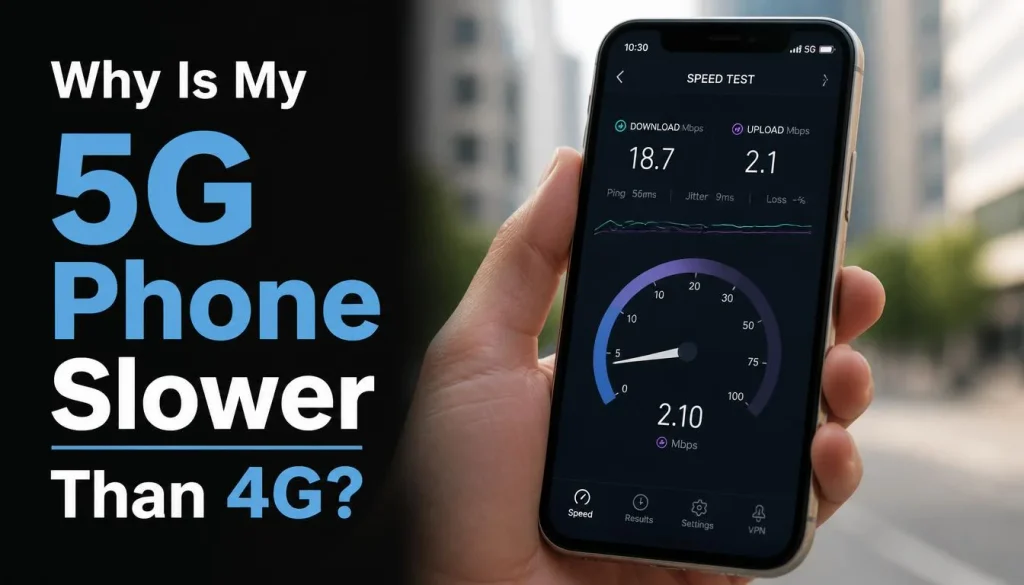
It can be frustrating to buy a 5G phone and discover that your internet connection is slower than it was on 4G.
Fortunately, this does not automatically mean your phone is faulty.
Weak 5G Signal
If your phone is near the edge of your carrier’s 5G coverage, the connection may be weak or unstable.
Try using the phone in a location with better reception and compare its performance.
Network Congestion
A busy 5G network may deliver slower speeds when many people are using it simultaneously.
Testing your connection at a different time or in another location can help you determine whether congestion is a factor.
Carrier or Plan Restrictions
Your mobile plan may have speed restrictions, reduced-speed data allowances, hotspot limits, or other conditions that affect performance.
Review your plan details or contact your carrier if the slowdown continues.
Phone Compatibility
An imported or incompatible device may not support all the network bands your carrier uses.
Check the exact model and carrier requirements before assuming that the phone can access every available 5G service.
How to Fix a Slow 5G Connection
Try these steps before replacing your phone:
- Turn Airplane Mode on briefly, then turn it off.
- Restart your phone.
- Move to a location with stronger network reception.
- Check whether your mobile data allowance or plan has speed restrictions.
- Compare 4G and 5G performance in the same location.
- Install available software updates.
- Contact your carrier if the problem continues.
For additional guidance on identifying compatible hardware, follow our step-by-step guide on how to check whether your phone supports 5G on iPhone and Android.
Do You Need a 5G SIM Card or a 5G Plan?
Not necessarily. The requirements depend on your mobile carrier, SIM provision, device, and market.
Some existing 4G SIM cards can access 5G when used with a compatible phone and an eligible plan. Other carriers may require a SIM replacement, account change, or particular plan to enable 5G.
Before upgrading, ask your carrier these questions:
- Does my current SIM support your 5G service?
- Does my current mobile plan include 5G access?
- Is my exact phone model compatible with your 5G network?
- Are there additional fees or speed restrictions?
- Will the phone support the network bands used in my area?
A 5G-capable phone cannot connect to 5G simply because it has the required hardware. The carrier must also provide compatible service in your location.
If you are buying an unlocked phone, check compatibility before completing the purchase. This is particularly important when buying a handset from another country.
Can a 5G Phone Work on a 4G Network?
Yes. Most 5G phones are designed to support compatible 4G networks as well.
When 5G coverage is unavailable, a compatible phone can connect to 4G, allowing you to keep using mobile data and other supported network services.
However, the exact experience depends on the phone, carrier, supported frequency bands, and account settings.
If your phone consistently struggles to maintain a 5G connection, selecting an available LTE or 4G option may improve reliability in some locations.
On supported iPhones, for example, you can find network choices under Settings, then Cellular or Mobile Data, followed by Cellular Data Options or Mobile Data Options. The available choices vary by device and carrier.
Android phones use different menu names depending on the manufacturer and software version. Look for Mobile Networks, Preferred Network Type, or a similar option.
Keep in mind that switching to 4G will not solve every connection problem. Weak coverage, a congested carrier network, or plan restrictions may also affect performance.
Can a 4G Phone Be Upgraded to 5G?
No. A phone that supports only 4G cannot gain genuine 5G connectivity through a software update alone.
5G connectivity requires compatible modem and radio hardware, along with software that supports the relevant network technology.
A manufacturer may update a phone’s software to improve connectivity or fix bugs, but that does not turn a 4G-only device into a 5G phone.
If you want to access 5G, you will need a compatible handset, suitable network coverage, and an eligible service plan.
Before buying a replacement, compare the price of an affordable 5G device with the cost of keeping your existing phone. If your current device still performs well, the decision may come down to whether you genuinely need the extra connectivity.
Is 4G Still Worth Buying in 2026? Will 4G Phones Stop Working?
A 4G phone can still be a reasonable purchase in 2026, particularly if you mainly use your phone for calls, messaging, browsing, and social media.
However, you should not assume that every older 4G phone will remain compatible with every carrier indefinitely.
Mobile operators manage their networks differently. Network retirement plans, supported frequency bands, and voice-calling requirements vary by country and provider.
There is an important distinction between a 4G network remaining available and a particular 4G phone being compatible with that network.
For example, in Australia, the 3G network shutdown affected some older 4G devices that could not meet the relevant voice or emergency-calling requirements. The Australian Communications and Media Authority provides guidance on mobile phones and emergency calls after the 3G shutdown.
This does not mean all 4G phones are affected.
Before buying an older handset, contact your carrier to confirm that it supports the required 4G bands, VoLTE calling, and emergency-calling functionality where applicable.
If the price difference is small and you plan to keep your phone for several years, choosing a compatible 5G device may be the more flexible option.
How to Choose Between a 4G and 5G Phone in the USA, UK, Canada, and Australia
The right choice depends on where you live, which carrier you use, and what you expect from your phone.
Check Coverage Where You Actually Use Your Phone
Do not rely exclusively on nationwide coverage claims.
Check the signal around your home, workplace, school, and regular travel routes. A phone that performs well in a city centre might offer a different experience in a rural location or inside a building.
Use the relevant coverage resources mentioned earlier, then verify the details with your intended carrier.
Check Your Phone and Carrier Compatibility
Look up the exact model number rather than relying only on the phone’s marketing name.
Compare its supported network bands with those used by your carrier. Also verify whether the device is unlocked and whether the carrier supports its required calling features.
This is particularly important when buying imported phones, refurbished devices, or discounted models intended for another market.
Compare Mobile Plans and Total Costs
A phone’s purchase price is only one part of the cost.
Compare monthly plan charges, data allowances, speed limits, hotspot policies, and any extra fees required to access 5G.
If a more expensive plan does not provide meaningful benefits for your usage, upgrading solely to access 5G may not be worthwhile.
Consider the Features Beyond Connectivity
A phone is something you use every day, so look at more than its network generation.
A good display, reliable battery, suitable storage, quality cameras, and dependable software support can make a bigger difference to your overall experience than 4G versus 5G alone.
Choose a device that meets your everyday needs and provides reasonable value over the time you expect to own it.
5G vs 4G Phone: Which One Should You Buy?
For most people shopping for a new smartphone, a compatible 5G phone is a sensible option when its price and specifications are comparable to a 4G alternative.
It gives you access to 5G where available while retaining compatible 4G connectivity, and it can provide faster downloads and better network performance in suitable conditions.
However, a 4G phone may still be a practical choice if you want to spend less, already have a reliable connection, and do not need the extra capabilities of 5G.
Here is a simple way to decide:
- Choose a 5G phone if you have good local coverage, frequently download large files, use a mobile hotspot, or want more connectivity flexibility for the years ahead.
- Consider a 4G phone if your needs are basic, your current network works well, and a 4G device offers significantly better value for your budget.
- Check compatibility first if you are buying an older, imported, or refurbished handset.
Do not pay extra for a 5G label while overlooking battery life, performance, software support, or network compatibility.
The best phone is the one that delivers a reliable connection and meets your needs without costing more than necessary.
Frequently Asked Questions
Is 5G Better Than 4G on a Phone?
Generally, 5G offers greater potential speed, lower latency, and increased network capacity. However, the actual advantage depends on coverage, carrier performance, device compatibility, and signal quality.
How Much Faster Is 5G Than 4G on a Phone?
There is no single speed difference that applies everywhere. A good 5G connection can be significantly faster than many 4G connections, but weak or congested 5G may perform worse than strong 4G.
Does a 5G Phone Have Better Battery Life Than a 4G Phone?
Not automatically. Battery life depends on factors such as hardware efficiency, signal strength, battery capacity, and usage. Some 5G connections can consume more power, particularly in weak-signal conditions.
Does 5G Use More Mobile Data Than 4G?
Not for the same amount of content downloaded. However, faster connectivity may encourage higher-resolution streaming, larger downloads, or more frequent use of data-intensive applications.
Can a 5G Phone Use 4G When There Is No 5G Signal?
Yes, provided the phone supports the available 4G network and is compatible with the carrier. A 5G phone can use 4G connectivity when 5G is unavailable.
Can a 4G SIM Card Work in a 5G Phone?
In many cases, yes, but it depends on the carrier, SIM provisioning, plan, and device. Contact your provider to confirm whether your existing SIM and plan support 5G.
Can I Switch My Phone From 5G to 4G?
Many phones allow you to select LTE or 4G in their mobile network settings. The options depend on the device and carrier. Switching to 4G can sometimes improve reliability or reduce power consumption in locations with weak 5G coverage.
Is 5G the Same as LTE?
No. LTE is a technology associated with 4G mobile networks, while 5G uses fifth-generation radio technology. A 5G phone may support both, but they are not the same network generation.
Will 4G Phones Stop Working?
There is no single shutdown date that applies to every country and carrier. Future network changes vary by market. Older devices may also lose service because they lack required network bands or calling features. Check your provider’s current compatibility requirements before buying or keeping an older phone.
Does 5G Have Better Signal Than 4G?
Not always. Signal strength depends on the carrier, frequency bands, distance from network sites, obstacles, and local conditions. A strong 4G connection may be more reliable than a weak 5G connection.
Is It Worth Buying a 4G Phone in 2026?
It can be, especially if you have a limited budget and the phone meets your needs. However, check software support, carrier compatibility, and local network requirements. When prices are similar, a good 5G phone may offer greater flexibility.
Conclusion
The choice between a 5G and 4G phone comes down to your needs, location, budget, and expectations.
5G can provide faster downloads, lower latency, and better capacity in suitable network conditions. It is particularly useful for people who regularly download large files, use mobile hotspots, or want more connectivity options in the years ahead.
Meanwhile, 4G remains suitable for many everyday activities, including browsing, messaging, streaming, and video calls. A reliable 4G connection can also provide a better experience than a weak 5G signal.
Before buying a phone, check local coverage, carrier compatibility, plan requirements, battery life, and software support. These factors will help you make a more informed decision than the 4G or 5G label alone.
Ultimately, choose the phone that offers the best combination of reliable connectivity, useful features, and value for your money.

“The right smartphone can make a bigger difference than you think.”
Hi, I’m Ethan Collins, a technology writer and smartphone enthusiast at PhoneProSolve.com.
My interest in smartphones started with a simple question: How do you know which phone is actually right for your needs?
With so many brands, models, features, specifications, operating systems, accessories, and price ranges available today, choosing the right phone can quickly become confusing. And when a phone starts overheating, charging slowly, draining its battery, running slowly, or developing other problems, finding a clear solution can be just as frustrating.
I created PhoneProSolve.com to make that process easier.
Through this website, I share practical smartphone guides, product comparisons, buying advice, troubleshooting tips, how-to guides, accessory information, and solutions to common phone problems.
I focus on turning complicated technical information into clear, practical, and easy-to-understand guidance that everyday readers can actually use.
Whether you’re searching for a smartphone with better battery life, a powerful device for gaming, a reliable camera phone, useful accessories, or simply trying to figure out why your current phone isn’t working properly, my goal is to help you find the information you need before making a decision.
I believe good recommendations should be based on careful research, real-world considerations, honest pros and cons, and the specific needs of the user—not simply marketing claims.
Through PhoneProSolve.com, I’m committed to helping readers understand their smartphones, solve common phone problems, choose useful products, and make smarter purchasing decisions with confidence.
— Ethan CollinsAuthor & Technology WriterPhoneProSolve.com