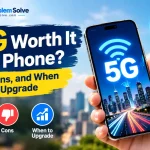
Is 5G worth it on a phone, or is 4G LTE still good enough for everyday use? The answer depends on where you live, how you use your phone, and whether upgrading would cost you extra money.
For many people buying a new smartphone, 5G is worth having because it can deliver faster downloads, lower latency, and better performance in supported areas. However, if your current 4G phone works well and you mainly browse the web, send messages, use social media, and watch videos, upgrading solely for 5G may not be worth the expense.
The biggest factor is not whether your phone displays a 5G icon. It is whether your local network can deliver a noticeably better experience.
In this guide, you will learn the real differences between 4G and 5G, how 5G affects battery life and mobile data, whether you need a new SIM card or plan, and how to decide if upgrading makes sense in the USA, UK, Canada, or Australia.
Is 5G Worth It on a Phone? The Quick Answer
Yes, 5G is worth it for many smartphone users, particularly those who regularly use mobile data, download large files, stream high-quality video, or rely on their phones as mobile hotspots.
However, not everyone needs to upgrade to a 5G phone immediately.
Here is a quick breakdown:
| Your Situation | Is 5G Worth It? |
|---|---|
| You are buying a new phone and the price difference is small | Usually yes |
| You frequently download large files using mobile data | Yes, with good 5G coverage |
| You use your phone as a mobile hotspot | Often yes |
| You play online games and need a responsive connection | Potentially, depending on latency and network quality |
| You mostly browse websites and send messages | 4G may be sufficient |
| Your current phone works well and you are happy with its speed | Probably not worth upgrading just for 5G |
| You live in an area with limited 5G coverage | Not necessarily |
| You have to spend significantly more for a 5G phone | Compare the overall value before buying |
The practical takeaway is simple: 5G is most worthwhile when it solves a real problem or comes at little additional cost.
You do not need to replace a perfectly good smartphone just because newer phones support a faster network.
What Difference Does 5G Make in Everyday Phone Use?
5G is the fifth generation of cellular mobile network technology. Compared with 4G LTE, it can offer higher data speeds, lower latency, and greater network capacity.
You can explore the technical details in our guide to what a 5G phone is, how it works, and how it differs from 4G.
But what does that mean when you are actually using your phone?
Faster Downloads and Uploads
One of the clearest benefits of 5G is the potential to transfer data faster.
For example, downloading a large game, saving videos for offline viewing, or uploading large files may take considerably less time when your phone has a strong 5G connection.
The improvement depends on your carrier, signal strength, network congestion, phone model, and plan. A strong 5G connection can outperform 4G substantially, but the difference is not guaranteed in every location.
Better Video Streaming
A reliable 5G connection can make high-resolution streaming more convenient, particularly when Wi-Fi is unavailable.
Videos may load faster, and buffering may be reduced when network performance is the limiting factor.
However, 5G will not automatically improve every streaming experience. Your video subscription, app settings, server performance, and actual connection speed still matter.
If your 4G connection already streams your favourite shows smoothly, the difference may be difficult to notice.
More Responsive Online Gaming
Latency describes how long data takes to travel between your device and another point in the network.
5G can reduce latency in suitable conditions, which may help online games, cloud gaming, and other interactive applications feel more responsive.
However, a 5G connection does not guarantee lower latency in every situation. Your distance from the game server, network congestion, Wi-Fi or mobile connection quality, and the game itself can all affect performance.
For competitive gaming, test the connection where you normally play rather than relying on the network label alone.
Better Performance in Busy Places
Mobile networks can become congested when many people connect at once.
5G can offer greater network capacity, potentially improving performance in busy shopping centres, stadiums, airports, and city centres.
The actual improvement depends on the network deployment and the carrier’s available capacity. A crowded 5G network can still perform poorly.
Faster Mobile Hotspot Connections
If you regularly connect a laptop or tablet to your phone’s hotspot, 5G can be particularly useful.
A strong connection may allow you to download work files, join video meetings, or access cloud applications more comfortably when you are away from Wi-Fi.
Before relying on 5G for this purpose, check your plan’s hotspot allowance, speed restrictions, and any additional charges.
5G vs. 4G LTE: Which Is Better for Everyday Use?
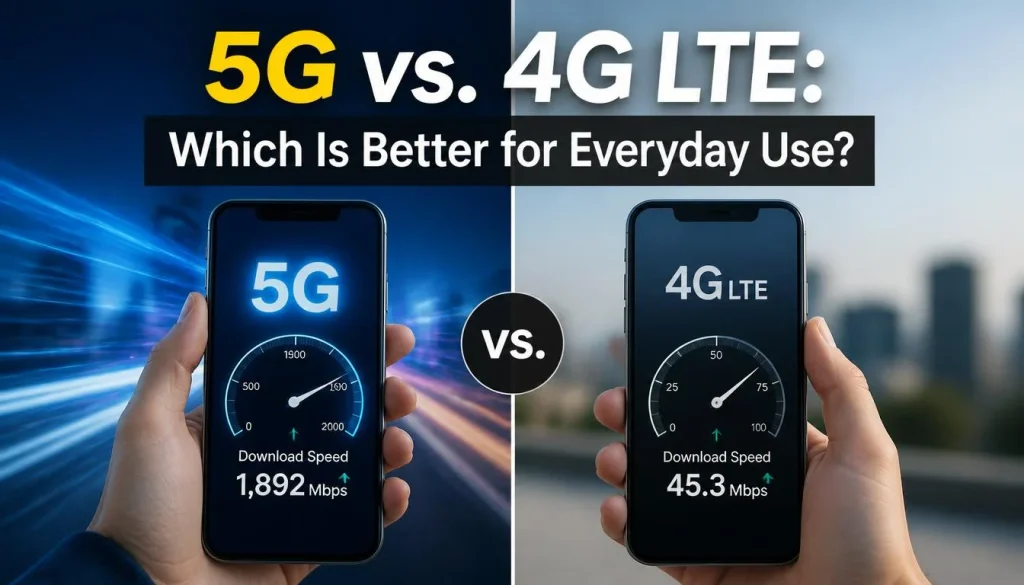
The difference between 4G and 5G is not simply that one is newer than the other. What matters is how each network performs in your particular location.
| Feature | 4G LTE | 5G |
|---|---|---|
| Web browsing and messaging | Generally sufficient | Often feels similar on a good 4G connection |
| Large file downloads | Can be fast | Can be much faster with good coverage |
| Video streaming | Usually handles common streaming needs | Can provide more headroom for high-quality streaming |
| Online gaming | Can offer a good experience | May provide lower latency in suitable conditions |
| Mobile hotspot | Useful for many tasks | Can offer faster hotspot performance |
| Network capacity | Depends on deployment and congestion | Can offer greater capacity |
| Coverage | Often established across many areas | Varies significantly by carrier and location |
| Battery consumption | Depends on device and signal conditions | Can use more or less power depending on conditions |
| Cost | Existing devices and plans may be cheaper | Some phones or plans may cost more |
Is 5G Always Faster Than 4G?
No. This is one of the most important points to understand before buying a new phone.
Some 5G networks prioritise broad coverage, while others use spectrum and network configurations that support higher performance in particular areas. A strong 4G LTE connection can sometimes outperform a weak or congested 5G connection.
Your experience also depends on whether your smartphone supports the frequency bands used by your carrier.
For example, an imported phone may advertise 5G support but lack compatibility with some of the bands used by a local operator.
If speed matters to you, compare actual performance on both networks at the places where you spend the most time.
Does 5G Use More Data Than 4G?
5G does not automatically consume more mobile data simply because it is faster.
If you download the same file or stream the same video at the same quality, the amount of data used is generally similar, regardless of whether the connection is 4G or 5G.
The difference comes from how you use that additional speed.
For example, a faster connection may make you more likely to stream videos at a higher resolution, download larger files, or watch more content without waiting for it to load. Those activities can increase your total data consumption.
Phone settings can also make a difference.
Apple explains in its official guide on using 5G with an iPhone that certain 5G data settings allow higher-quality media, larger cellular downloads, and other features that can use more mobile data.
How to Avoid Using Too Much Mobile Data
If your plan has a monthly data limit, these steps can help:
- Set video-streaming apps to a suitable quality rather than automatically choosing the highest resolution.
- Download large files over Wi-Fi whenever practical.
- Review which apps consume the most mobile data.
- Disable unnecessary automatic downloads and background activity.
- Check your carrier’s data allowance and hotspot restrictions.
If you have an unlimited plan with no meaningful speed restrictions, additional data use may be less of a concern. Nevertheless, hotspot limits and fair-use conditions can still apply.
Does 5G Drain Your Phone Battery Faster?
5G can affect battery life, but it does not drain every phone’s battery faster in every situation.
Battery consumption depends on your smartphone’s modem, software, network settings, signal strength, and how the device handles connections between 4G and 5G.
When the 5G signal is weak, maintaining a reliable connection may use additional power. On the other hand, completing a large download more quickly can reduce the time spent transferring data.
The result varies by phone and network conditions.
Does Weak 5G Coverage Affect Battery Life?
It can.
If your phone frequently switches between network modes or struggles to maintain a connection, battery consumption may increase. The same general principle applies to other mobile network technologies: poor reception can make maintaining connectivity more demanding.
This is particularly relevant if you spend a lot of time indoors, travel through areas with inconsistent coverage, or live outside a well-served network area.
How to Save Battery While Using 5G
Try these practical steps:
- Use your phone’s automatic network mode if it offers one.
- Keep your operating system and carrier settings updated.
- Review background app activity if battery usage seems unusually high.
- Compare battery life with 5G and LTE in the same location to see whether your connection affects consumption.
On compatible iPhones, 5G Auto can automatically switch to LTE when 5G does not provide a noticeably better experience, helping save battery life. Apple’s 5G settings guide explains the available options.
The exact menu and available settings vary by device, operating system, and carrier.
You do not need to disable 5G automatically to save battery. Try the available settings and judge the result based on your own usage.
Is 5G Worth the Extra Cost?
The answer depends on how much more you need to pay and what you receive in return.
Some smartphones offer 5G without a substantial price premium, while others include it alongside more expensive hardware and features. Similarly, some carriers offer 5G on existing plans, while others impose particular plan or eligibility requirements.
When Paying More for 5G Makes Sense
Paying a little more may be worthwhile when:
- You use mobile data heavily.
- Your home, workplace, and regular travel routes have reliable 5G coverage.
- You often download large files or use mobile hotspots.
- You intend to keep the phone for several years.
- The phone also offers good battery life, performance, camera quality, storage, and software support.
Consider the overall package, not just the network specification.
A slightly cheaper 5G phone with poor battery life or limited storage may be a worse choice than a well-rounded alternative. Likewise, a quality 4G phone may provide better value if your usage does not require faster mobile connectivity.
Should You Pay More for a 5G Mobile Plan?
Not necessarily.
Before changing plans, compare the monthly price, data allowance, hotspot limits, speed restrictions, roaming conditions, and contract terms.
If your current plan already includes 5G, you may not need to pay anything extra to access it with a compatible device.
If upgrading would increase your monthly bill, estimate the additional cost over the entire contract period. A small monthly difference can become significant over two years.
The best plan is the one that provides the coverage, allowance, and performance you need at a reasonable price.
Do You Need a New 5G Phone, SIM Card, or Plan?
A 5G phone alone does not guarantee access to 5G service. Several requirements must be met.
You Need a Compatible Phone
Your smartphone must support 5G hardware and the network bands used by your mobile carrier.
Check the exact model number rather than relying solely on the phone’s marketing name. Different regional versions of the same model can support different combinations of network bands.
This is especially important when purchasing an unlocked or imported smartphone for use in another country.
You Need 5G Coverage
Your carrier must offer compatible 5G service in the area where you want to use it.
Coverage may differ between neighbourhoods, buildings, roads, and rural locations. Even within a supported area, indoor reception may be weaker than outdoor reception.
Do You Need a New SIM Card for 5G?
Not always.
Some existing SIM cards can work in compatible 5G phones, while other users may need a replacement SIM, an eSIM activation, or an update to their account.
Requirements depend on the carrier, the SIM or eSIM configuration, and the device.
Before purchasing a new SIM, contact your network provider to confirm whether your existing SIM and plan support 5G.
Can a 5G Phone Work on 4G LTE?
Yes, most 5G phones are designed to support compatible 4G LTE networks as well.
If you move outside 5G coverage, a compatible phone can generally fall back to 4G LTE when that network is available and supported by your carrier.
This makes a 5G phone useful even when 5G coverage is not continuous.
However, you should still check network-band compatibility when buying an imported or unlocked phone.
Will 4G Phones Stop Working?
There is no single worldwide date when all 4G phones will stop working.
The future of a particular device depends on the carrier’s network plans, the services it supports, and whether it meets relevant requirements for calls and emergency connectivity.
The withdrawal of older network technologies does not automatically mean that every 4G phone will stop working everywhere. Equally, purchasing a 4G-only phone may limit your options over a longer ownership period.
If you are buying a phone today and plan to keep it for several years, choosing a compatible 5G model can provide greater flexibility where 5G is available.
However, do not replace your current phone solely because of assumptions about a universal 4G shutdown. Check the announcements and compatibility guidance from your actual carrier.
Why Is Your 5G Phone Not Getting 5G Speeds?
Buying a 5G phone does not guarantee that every connection will be fast. If your phone displays a 5G icon but performance is disappointing, check the following factors.
1. Your 5G Signal Is Weak
Signal strength can vary inside buildings, underground, behind thick walls, and farther from network equipment.
Try testing your connection outdoors or in another nearby location. If performance improves significantly, local reception may be part of the problem.
2. Your Network Is Congested
When many people use the same network resources at once, performance can decrease.
Compare your speed at different times of day. If your connection is consistently better outside busy periods, congestion may be contributing to the problem.
3. Your Phone Does Not Support All Local 5G Bands
A smartphone may support 5G but lack compatibility with some frequency bands used by a particular carrier.
Check the exact model number and the carrier’s device compatibility requirements, especially if the phone was imported.
4. Your Plan Has Speed or Hotspot Restrictions
Some mobile plans apply different rules to hotspot use, high-speed data allowances, or network priority.
Review your plan details before assuming the phone itself is defective.
5. Your Phone Settings Need Attention
Make sure 5G is enabled where available and that your carrier supports the device and plan.
If 5G does not appear, try toggling Airplane Mode on and off, restarting the phone, and checking for software or carrier-setting updates.
For compatible iPhones, Apple provides additional steps in its official 5G troubleshooting instructions.
If the problem continues, contact your carrier to check local service availability, account eligibility, and possible network issues.
How to Check 5G Coverage in Your Area
Before buying a 5G phone or switching carriers, check coverage at home, at work, and along your usual travel routes.
Coverage maps are useful starting points, but they are predictions rather than guarantees of the experience you will receive at every location.
USA: Check the FCC National Broadband Map
People in the United States can use the FCC National Broadband Map to inspect reported mobile broadband availability and compare providers.
Look at the mobile coverage information rather than only the fixed broadband information. The FCC explains that mobile maps are intended to show areas where a connection may be available outdoors or in a moving vehicle; they do not establish indoor reception.
Also check the coverage map and device compatibility information provided by your own carrier.
UK: Use Ofcom’s Mobile Coverage Checker
In the United Kingdom, Ofcom’s Map Your Mobile service allows users to enter a postcode and examine local 4G and 5G coverage information for the main network operators.
Check the coverage where you actually use your phone. The tool also distinguishes between predicted coverage and likely performance, which can be useful when comparing providers.
Remember that the result is a guide. Buildings, local terrain, network congestion, and your phone’s antenna can affect the signal you receive.
Canada: Check the National Broadband Map
Canadian readers can explore the Government of Canada’s National Broadband Map for network availability information.
The map includes mobile coverage information, but the displayed data and update dates matter. You should also consult the current coverage map of the Canadian carrier you plan to use.
If you live in a rural area, check the exact community and nearby routes rather than relying on province-wide coverage figures.
Australia: Compare Mobile Coverage Maps
In Australia, start with the coverage maps published by your intended mobile operator.
The Australian Communications and Media Authority’s guidance on mobile coverage maps explains the standardised coverage-map requirements introduced in 2026.
These rules are intended to make it easier to compare mobile coverage across providers. Nevertheless, predicted coverage does not guarantee strong reception inside every building or at every point along a road.
For an important purchasing decision, verify local coverage and confirm that your phone supports the operator’s network bands.
Who Should Upgrade to a 5G Phone?
A 5G phone is a sensible choice for some people, but the decision depends on more than network technology.
You Should Consider Upgrading If…
You are already planning to buy a new phone. If a suitable 5G model costs about the same as a comparable 4G alternative, choosing 5G can be a practical way to gain additional connectivity options.
You regularly use mobile data. Faster downloads and improved performance can make a meaningful difference when you work, stream, or transfer files away from Wi-Fi.
You have reliable local coverage. The benefits are more useful when the networks you use regularly offer dependable 5G service.
You rely on your phone as a hotspot. A suitable 5G connection can improve mobile internet access for a laptop or tablet.
You intend to keep your next phone for years. A compatible 5G device gives you access to supported 5G networks as you continue using the phone, although future compatibility still depends on the device and carrier.
You Can Probably Keep Your 4G Phone If…
Your current phone performs well, your applications run smoothly, and you rarely experience connection problems.
You may also be better off keeping your current device if most of your internet use happens over Wi-Fi or if 5G coverage is poor in the places that matter to you.
If you would have to spend a significant amount to replace a functioning phone, compare the expected benefits with the cost of the upgrade.
There is no need to spend money on a feature that will not meaningfully improve your daily experience.
How to Decide If 5G Is Worth It for You in Five Minutes
Use this checklist before choosing your next phone.
Step 1: Check your current connection.
Run a few speed tests over 4G LTE where you normally use your phone. Pay attention to download speed, upload speed, reliability, and whether applications load comfortably.
Step 2: Check local 5G availability.
Use your carrier’s coverage map and the relevant official resources. Check your home, workplace, and regular travel routes.
Step 3: Identify what you actually need.
Do you want faster downloads, a better hotspot connection, more responsive gaming, or simply a reliable phone for daily use?
If your current connection already handles everything comfortably, the practical benefit of upgrading may be limited.
Step 4: Compare the complete cost.
Consider the phone price, monthly plan charge, data allowance, hotspot restrictions, and contract conditions. Do not focus only on the upfront price.
Step 5: Compare phones rather than network labels.
Look at battery life, performance, software support, storage, camera quality, and compatibility with your local carrier.
A phone that offers good overall value is usually a better purchase than one chosen solely because it advertises 5G.
If the coverage is reliable, the additional cost is reasonable, and the performance improvement matters to you, upgrading is easier to justify.
Frequently Asked Questions
Is 5G Worth It for Normal Phone Use?
For ordinary tasks such as messaging, browsing, navigation, and social media, a good 4G LTE connection is often sufficient.
5G may still provide benefits when downloading files or using data-intensive applications, but many everyday activities do not require its full speed potential.
Is 5G Worth It in 2026?
5G is worth considering when buying a new smartphone in 2026, particularly if the device is competitively priced and your carrier offers good coverage.
However, replacing a working 4G phone solely for 5G is not automatically a good investment. Your budget, current performance, and local network availability should determine the decision.
Does 5G Work Better Indoors Than 4G?
Not always.
Indoor reception depends on the frequency used, building materials, distance from network equipment, interference, and the phone’s antenna.
Some 5G signals offer useful indoor coverage, while higher-frequency signals may have more difficulty penetrating obstacles. A reliable 4G connection may perform better inside a particular building.
Check reception where you spend the most time instead of assuming one technology will always work better indoors.
Can I Use a 5G Phone Without a 5G Plan?
In many cases, yes. A compatible 5G phone can often use supported 4G LTE service when the carrier and plan allow it.
However, access to 5G itself may require an eligible plan or account configuration. Check your carrier’s requirements before purchasing a device or changing plans.
Is 5G Worth It in Rural Areas?
It depends on the coverage available in your particular area.
If your home and regular travel routes have reliable 5G coverage, a 5G phone may be worthwhile. If coverage is limited and your existing 4G connection is reliable, the extra expense may offer little benefit.
Always check local network availability rather than relying on national coverage claims.
Is 5G Better for Gaming?
It can be, particularly when a suitable 5G network provides lower latency and stable performance.
However, 5G does not guarantee a better gaming experience. Network congestion, server distance, signal quality, and the game itself still matter.
A strong, stable connection is more useful than a 5G icon with poor performance.
Should I Turn Off 5G to Save Battery?
Not automatically.
Modern phones may provide automatic network settings designed to balance speed and battery life. If you experience unusually high battery consumption in an area with weak 5G coverage, comparing battery performance on LTE may help identify whether your connection is contributing to the problem.
Choose the setting that provides the best balance for your device and usage.
Final Verdict: Is 5G Worth It on a Phone?
For many people, 5G is worth having when buying a new phone, but it is not worth upgrading for everyone.
If you use mobile data regularly, download large files, rely on a hotspot, or have excellent 5G coverage, the technology can offer practical advantages over 4G LTE.
If you mainly use messaging apps, browse websites, stream videos comfortably, and spend most of your time connected to Wi-Fi, a good 4G phone may continue to meet your needs.
Before buying, check your local coverage, plan requirements, phone compatibility, and total cost. If the benefits are clear and the price difference is small, 5G is a sensible choice.
Otherwise, keeping your current phone and spending your money only when you need a genuine upgrade may be the smarter decision.
The best phone is not necessarily the one with the newest network technology. It is the one that provides the performance, battery life, reliability, and value you actually need.

“The right smartphone can make a bigger difference than you think.”
Hi, I’m Ethan Collins, a technology writer and smartphone enthusiast at PhoneProSolve.com.
My interest in smartphones started with a simple question: How do you know which phone is actually right for your needs?
With so many brands, models, features, specifications, operating systems, accessories, and price ranges available today, choosing the right phone can quickly become confusing. And when a phone starts overheating, charging slowly, draining its battery, running slowly, or developing other problems, finding a clear solution can be just as frustrating.
I created PhoneProSolve.com to make that process easier.
Through this website, I share practical smartphone guides, product comparisons, buying advice, troubleshooting tips, how-to guides, accessory information, and solutions to common phone problems.
I focus on turning complicated technical information into clear, practical, and easy-to-understand guidance that everyday readers can actually use.
Whether you’re searching for a smartphone with better battery life, a powerful device for gaming, a reliable camera phone, useful accessories, or simply trying to figure out why your current phone isn’t working properly, my goal is to help you find the information you need before making a decision.
I believe good recommendations should be based on careful research, real-world considerations, honest pros and cons, and the specific needs of the user—not simply marketing claims.
Through PhoneProSolve.com, I’m committed to helping readers understand their smartphones, solve common phone problems, choose useful products, and make smarter purchasing decisions with confidence.
— Ethan CollinsAuthor & Technology WriterPhoneProSolve.com