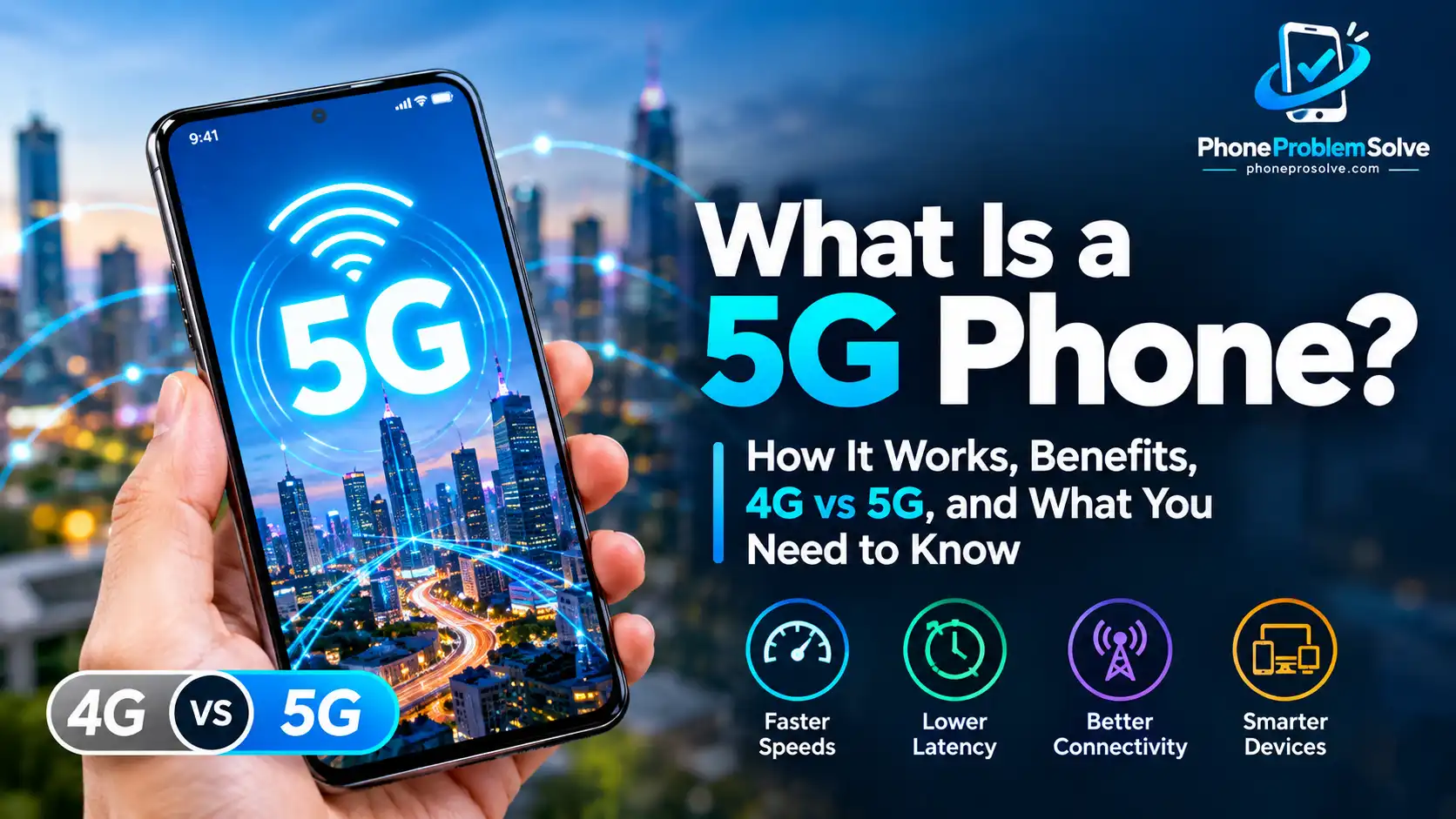
A 5G phone is a smartphone that has the hardware and software needed to connect to a 5G cellular network. Compared with 4G LTE, 5G can offer faster data speeds, lower latency, and greater network capacity. But there is an important detail many people miss: simply owning a 5G phone does not guarantee that you will always get a fast 5G connection.
Your actual experience depends on the phone, carrier, 5G coverage, network band, plan, and even your location.
This guide explains what a 5G phone is, how it works, how it compares with 4G, how to check whether your phone supports 5G, why 5G can sometimes be slower than 4G, and whether you actually need a 5G phone.
What Is a 5G Phone?
A 5G phone is a smartphone that can connect to fifth-generation cellular networks, commonly called 5G.
The main difference between a 5G phone and an older 4G-only phone is the cellular modem and radio hardware inside the device. A 5G phone is designed to communicate with compatible 5G networks, while a 4G-only phone cannot connect to a true 5G network.
Most modern 5G phones can also connect to 4G LTE networks. That means buying a 5G phone does not mean you are limited to 5G. When 5G is unavailable, the phone can typically fall back to 4G or another supported network technology. Carrier requirements and device compatibility can vary by market.
In simple terms:
A 5G phone is a phone capable of using 5G cellular networks.
It does not mean the phone will always use 5G, nor does the “5G” label automatically mean you will get extremely fast internet everywhere.
What Does 5G Mean on a Phone?
When you see 5G at the top of your phone’s screen, it generally means your phone is connected to, or has access to, a 5G network provided by your carrier.
However, the 5G icon should not be treated as a guarantee of a particular download speed.
Two people can both see “5G” on their phones and have very different experiences. One person might get excellent speeds while another gets mediocre performance because of differences in coverage, spectrum, signal strength, congestion, device compatibility, or network configuration.
Apple also notes that the exact meaning and behavior of 5G icons can depend on the carrier’s network configuration. On some iPhones, a 5G indicator can even appear in situations where 5G coverage is not actually available.
So, when your phone says 5G, think of it as a network indicator, not a speed certificate.
How Does a 5G Phone Work?
The basic process is easier to understand than it sounds.
Your phone contains a cellular modem that communicates with nearby mobile network equipment. When you are within a compatible 5G coverage area, the phone connects to the carrier’s 5G network and uses radio spectrum to send and receive data.
A simplified connection looks like this:
5G Phone → Cellular Network → Carrier Network → Internet
5G uses a radio technology known as 5G New Radio (5G NR). It can operate across different types of spectrum, including lower-frequency bands, mid-band spectrum, and higher-frequency millimeter-wave spectrum.
The spectrum being used makes a major difference.
Lower-frequency 5G can travel farther and penetrate buildings more effectively, while higher-frequency spectrum can provide very high capacity and speeds over shorter distances.
This is one reason why simply asking “How fast is 5G?” does not have one universal answer.
5G Phone vs 4G Phone: What’s the Difference?
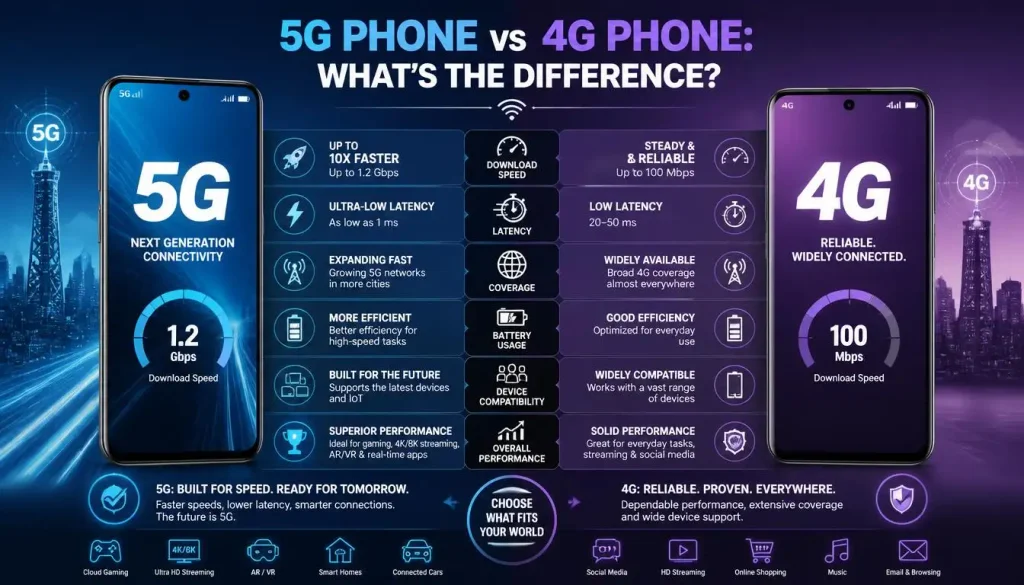
The biggest difference is network capability.
| Feature | 4G Phone | 5G Phone |
|---|---|---|
| 4G LTE support | Yes | Usually yes |
| 5G support | No | Yes |
| Potential download speed | Fast | Generally higher |
| Latency | Higher | Generally lower |
| Network capacity | Lower | Higher |
| Newer network technologies | Limited | Supported |
| Future network compatibility | More limited | Better suited to newer networks |
5G was designed to improve more than raw download speed. It can increase network capacity and reduce latency, which can make some activities feel more responsive. Qualcomm describes 5G as a broader platform designed for higher data rates, lower latency, greater capacity, and more flexible spectrum use.
That said, a good 4G connection can still be more than enough for many people.
If you mainly use your phone for messaging, email, maps, social media, browsing, and occasional video streaming, you may not notice a dramatic difference every day.
What Are the Benefits of a 5G Phone?
The benefits of 5G depend on your network and how you use your phone, but there are several situations where it can make a noticeable difference.
Faster Downloads
Large apps, videos, documents, and other files can download faster on a strong 5G connection than on many 4G connections.
The improvement can be especially noticeable when downloading large files while away from Wi-Fi.
Better High-Quality Streaming
A strong 5G connection can make high-resolution video streaming easier, particularly when the network is not congested.
However, streaming quality is also affected by your subscription, the service you are using, and your actual network speed.
Lower Latency
Latency is the time it takes for data to travel between your device and the network.
Lower latency can make interactive activities feel more responsive. This can be useful for online gaming, video calls, cloud applications, and other real-time services. 5G was designed with significantly lower latency capabilities than earlier cellular generations.
Better Performance in Busy Areas
5G also brings improvements in network capacity. That can become useful in places where many people are connected at the same time, such as stadiums, airports, concerts, shopping centres, and busy downtown areas.
Faster Mobile Hotspot Performance
A 5G phone can also be useful as a mobile hotspot when the carrier’s network and your plan support it.
For example, you might use your phone to connect a laptop when there is no Wi-Fi available.
Of course, hotspot speeds and data allowances are controlled by the carrier and plan you use.
Is 5G Always Faster Than 4G?
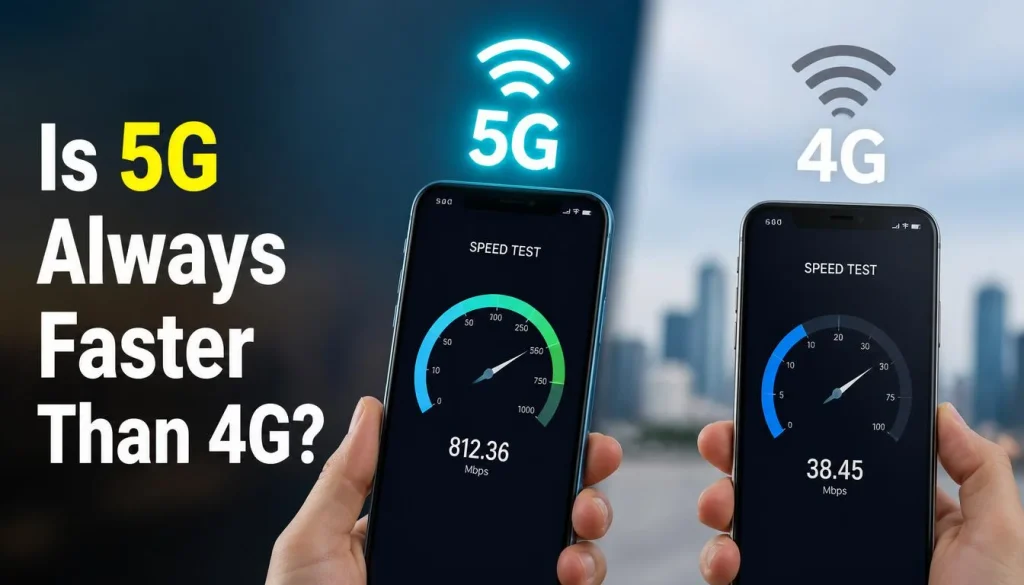
No.
This is one of the most important things to understand about 5G.
A 5G connection can be significantly faster than 4G, but 5G is not automatically faster in every situation.
Your 5G experience can depend on:
- The type of 5G spectrum being used
- Signal strength
- Your location
- Network congestion
- Your phone model
- Supported network bands
- Carrier configuration
- Your mobile plan
- Indoor or outdoor conditions
For example, a weak or congested 5G connection may perform worse than a strong 4G LTE connection.
Verizon explicitly distinguishes between lower-band 5G, which can provide broad coverage with performance that may be similar to 4G LTE, and its higher-performing Ultra Wideband service.
That is why seeing “5G” on the screen is not enough to judge the quality of your connection.
Why Is My 5G Slower Than 4G?
If your 5G phone is slower on 5G than it is on 4G, there is usually a reason.
Weak 5G Signal
Your phone may be connected to 5G, but the signal may be too weak to provide good performance.
This can happen indoors, behind thick walls, in underground areas, or farther away from the network equipment.
Network Congestion
A network can become slower when many people are using it at the same time.
A crowded 5G cell can sometimes perform worse than a less-congested 4G connection.
Different 5G Spectrum
Not all 5G uses the same frequency range.
Low-band 5G prioritizes coverage, while mid-band generally offers a stronger balance between coverage and speed. High-band or mmWave can offer extremely high capacity and speed but generally has shorter range.
Phone Compatibility
A phone may support 5G but not support every 5G band used by your carrier.
This is especially important with imported or regional phone versions.
Carrier Limitations
Your plan may also affect the performance you receive. Some carriers manage data speeds, hotspot usage, video quality, or network priority differently across plans.
So before deciding that “5G is bad,” test the same location on both 5G and 4G. The result can tell you a lot.
Do I Really Need a 5G Phone?
Not everyone needs a 5G phone.
Whether you should buy one depends on how you use your phone and how good 5G coverage is where you live and work.
A 5G phone makes more sense when:
- You are buying a new phone anyway.
- You regularly download large files.
- You stream lots of video.
- You play online games.
- You use mobile hotspot frequently.
- You live in an area with strong 5G coverage.
- You plan to keep your next phone for several years.
A 4G phone may still be enough when:
- You mainly make calls and send messages.
- You mostly browse websites and social media.
- Your current phone already feels fast enough.
- Your area has limited 5G coverage.
- You are trying to minimize the cost of a phone upgrade.
For many buyers, the real question is not “Is 5G better?” but:
“Will 5G make a meaningful difference in the way I use my phone?”
That is a much better way to decide.
What Do You Need to Use 5G on a Phone?
Having a 5G phone is only one part of the equation.
You generally need four things:
A 5G-Compatible Phone
The phone must contain the necessary 5G hardware and support the relevant networks and bands.
A Carrier With 5G Service
Your network provider must offer 5G in your area.
5G Coverage
You need to be inside an area where that carrier provides compatible 5G service.
A Compatible Plan
Some carriers require a specific plan or 5G access to use the service.
Apple, for example, states that compatible iPhones require a network provider that supports 5G and a 5G mobile plan.
So the basic formula is:
5G Phone + Compatible Plan + 5G Coverage + Network Compatibility = 5G Access
Do You Need a 5G Plan or a New SIM?
This is where things become carrier-specific.
Some users can move a compatible SIM or eSIM from an older device to a 5G phone and continue using cellular service, while others may need the carrier to update the line or activate 5G.
Apple notes that an existing SIM can sometimes be used in a 5G iPhone, although the network provider may need to configure it for 5G in certain cases.
So there is no universal rule saying that every 5G phone needs a brand-new physical SIM.
Before changing your SIM, check your carrier’s current 5G requirements.
Can a 5G Phone Use a 4G SIM?
In many cases, yes, but it depends on the carrier and the SIM configuration.
A 5G phone is generally backward-compatible with supported 4G LTE networks, so it does not suddenly stop working when 5G is unavailable.
However, having a 5G-capable phone and a working SIM does not necessarily mean that 5G access is activated on your line.
Your carrier may require a compatible plan, account configuration, or specific SIM/eSIM support.
That is why checking your carrier’s requirements is more reliable than assuming that every SIM works identically.
Can a 4G Phone Use 5G?
No.
A phone that is genuinely 4G-only cannot connect to a 5G cellular network because it does not contain the necessary 5G radio hardware.
You cannot turn a 4G-only phone into a 5G phone simply by changing the SIM card or enabling a setting.
However, a 4G phone can continue to use 4G LTE in an area where the carrier also offers 5G, assuming the carrier still supports the relevant 4G service.
A 5G-capable device is required to actually access a carrier’s 5G network.
How Do I Know If My Phone Is 5G?
There are several ways to find out whether your phone supports 5G.
Check the Phone Settings
On many Android phones, look under:
Settings → Mobile Network / Connections → Mobile Network
The exact names vary by manufacturer and Android version.
If your phone has options related to 5G network modes, that is a strong indication that the device supports 5G.
Check Your iPhone Settings
On compatible iPhones, go to:
Settings → Cellular or Mobile Data → Cellular Data Options → Voice & Data
Depending on the model, carrier, and region, you may see options such as 5G Auto, 5G On, or LTE. Apple says that seeing the relevant 5G settings is one way to confirm that the device is 5G-capable.
Check the Exact Model Number
This is even more reliable when buying a used or imported phone.
Search the manufacturer’s specifications for your exact model number and look for supported 5G bands.
A phone can have the same marketing name in different regions while using different hardware or supported bands.
Why Is My 5G Phone Not Connecting to 5G?
A 5G-capable phone can still show 4G or LTE for several reasons.
You Are Outside 5G Coverage
The simplest explanation is that 5G is not available where you are.
5G Is Disabled
Check your mobile network settings and make sure 5G is allowed.
On iPhone, for example, the network options can be changed under the Cellular or Mobile Data settings.
Your Plan Does Not Include 5G
Some plans require 5G access to be enabled.
Your Phone Does Not Support the Carrier’s 5G Bands
This is particularly important with international or imported phones.
The Network Is Temporarily Having Problems
Carrier maintenance, outages, congestion, and local network conditions can affect connectivity.
Try a Quick Network Reset
A simple troubleshooting step is to turn Airplane Mode on for a few seconds and then turn it off.
If the problem continues, restart the phone and check for carrier or software updates.
Apple recommends checking carrier support, plan eligibility, coverage, network settings, and Airplane Mode when 5G is not appearing on a compatible iPhone.
Why Is My 5G Phone Showing 5G but Internet Is Slow?
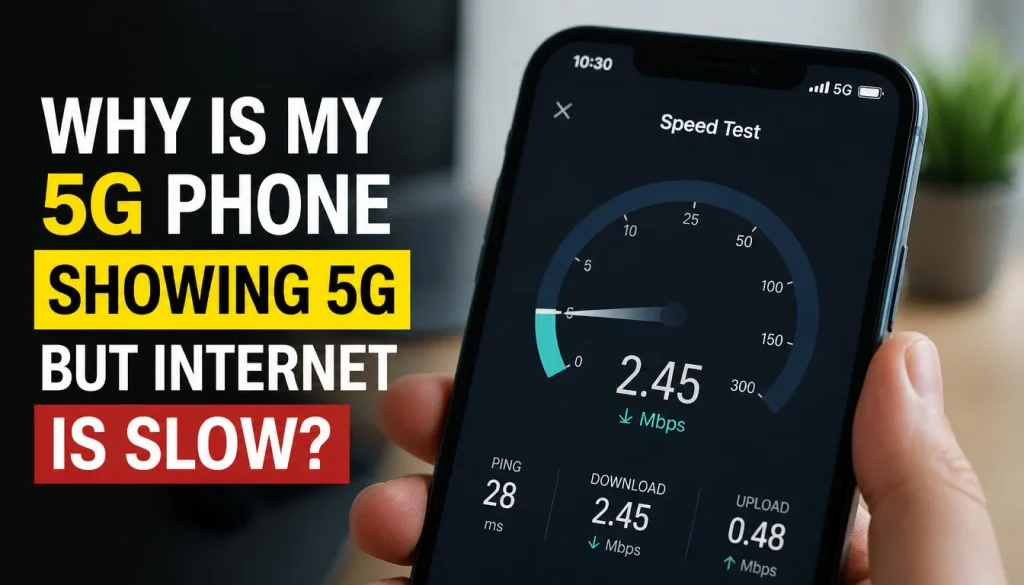
Seeing 5G does not necessarily mean the connection is excellent.
Here are some common reasons:
Weak signal: The phone can detect a 5G network but may struggle to maintain a strong connection.
Congestion: A busy cell tower can serve many users at once.
Low-band 5G: Some 5G deployments prioritize coverage rather than maximum speed.
Poor indoor conditions: Walls, windows, building materials, and your location inside a building can affect cellular performance.
Carrier policies: Your plan may have different speed, hotspot, or network-priority rules.
Device compatibility: Your phone may not support all of the carrier’s available 5G bands.
If 5G is unusually slow, compare the same location on 4G LTE. If LTE consistently performs better, temporarily using LTE may provide a better experience.
Does 5G Drain Your Phone Battery?
It can, but the answer is not simply “5G always uses more battery.”
5G radio usage varies by phone, network conditions, signal strength, network mode, and how the phone switches between 4G and 5G.
A weak 5G connection may be particularly frustrating because the phone can spend more effort maintaining connectivity.
Modern phones also include power-saving features designed to balance performance and battery life.
For example, Apple’s 5G Auto mode can automatically switch between 5G and LTE when 5G does not provide a noticeably better experience, with the goal of saving battery life. Apple also warns that forcing 5G whenever it is available may reduce battery life.
If you notice poor battery life and don’t need 5G at a particular location, testing LTE-only mode can help you determine whether the network connection is part of the problem.
What Do 5G, 5G+, 5G UC, 5G UW and 5GE Mean?
These labels can be confusing because carriers do not always use the same terminology.
5G
This generally indicates a standard 5G connection or availability.
5G+
“5G+” is a carrier-specific label used to indicate enhanced or higher-performance 5G service in supported areas. The exact technology behind the label depends on the carrier and market.
5G UC
T-Mobile uses 5G UC, which stands for 5G Ultra Capacity. T-Mobile says the label indicates its mid-band and/or mmWave 5G and represents its higher-capacity 5G service.
5G UW
Verizon uses 5G Ultra Wideband, commonly shown as 5G UW on supported devices.
Verizon describes Ultra Wideband as its higher-performing 5G service, using mid-band and high-band spectrum, while its broader low-band 5G service focuses more on coverage.
5GE
AT&T historically used the 5G Evolution (5GE) label for parts of its LTE network with upgraded technologies. It was not the same thing as a true 5G network connection. AT&T itself described 5G Evolution as a step toward 5G based on improvements to its LTE network.
Because carrier branding can change, the safest approach is to check the current network terminology used by your carrier rather than assuming that every “5G-looking” icon represents the same type of connection.
Low-Band vs Mid-Band vs mmWave 5G
Not all 5G networks are built the same way.
Low-Band 5G
Low-band spectrum is useful for broader coverage.
It generally travels farther and can work better across larger areas than higher-frequency spectrum.
The trade-off is that it may not deliver the highest possible 5G speeds.
Mid-Band 5G
Mid-band is often considered a practical balance between coverage and performance.
It can provide substantially better speed and capacity than many low-band deployments without the extremely short range associated with the highest-frequency spectrum.
mmWave 5G
Millimeter-wave, or mmWave, operates at very high frequencies.
It can deliver extremely high capacity and very fast data rates, but its range is generally shorter and its signal can be affected more by physical obstacles.
5G is designed to operate across a broad range of spectrum, from lower-frequency bands to much higher-frequency mmWave bands.
This is another reason why two phones showing a 5G icon can have completely different speeds.
Does Every 5G Phone Work With Every 5G Network?
No.
This is especially important when purchasing an unlocked, imported, or used phone.
A phone may support 5G but lack some of the bands used by your carrier.
For example, manufacturers often sell different regional versions of the same smartphone. The exact model can support different combinations of LTE and 5G bands depending on the market.
Samsung’s specifications for current 5G models show that supported LTE and 5G bands can vary by device model and include multiple band combinations.
Before buying an imported phone, check:
- The exact model number
- Supported 4G LTE bands
- Supported 5G bands
- Carrier compatibility
- VoLTE requirements
- eSIM support, if needed
- Regional software limitations
This is particularly important if you are buying a phone from another country and planning to use it in the USA, UK, Canada, or Australia.
Is 5G the Same as 5GHz Wi-Fi?
No.
The names look similar, but they refer to different technologies.
5G usually means the fifth generation of cellular mobile technology.
5GHz Wi-Fi refers to a Wi-Fi frequency band used by wireless routers.
A phone can be connected to 5GHz Wi-Fi while using 4G cellular service. Likewise, a phone can use 5G cellular data while connected to a Wi-Fi network.
So:
5G = Cellular network technology
5GHz = Wi-Fi frequency band
They are not the same thing.
Can You Use a 5G Phone as a Hotspot?
Yes, most modern 5G smartphones can be used as mobile hotspots when the carrier and plan allow it.
A 5G phone can share its cellular internet connection with another device, such as:
- A laptop
- Tablet
- Another smartphone
- Some smart devices
The biggest limitation is your mobile plan.
Some plans include generous hotspot data while others impose separate limits or reduce hotspot speeds after a certain amount of usage.
So a phone having fast 5G does not automatically mean its hotspot will provide unlimited high-speed data.
How Much Faster Is 5G Than 4G?
There is no single real-world number that applies to every user.
The 5G standard was designed to support much higher peak data rates than 4G, along with lower latency and greater network capacity. Qualcomm cites theoretical peak rates of up to 20 Gbps under the relevant specifications, but real-world phone speeds are usually much lower and vary by network, spectrum, device, and location.
This distinction is important.
A network’s maximum theoretical speed is not the same as the speed you will see on a speed test.
Your actual result may be influenced by:
- Signal strength
- Spectrum
- Network congestion
- Carrier infrastructure
- Device hardware
- Server location
- Time of day
- Indoor or outdoor conditions
That is why a realistic 5G review should focus on actual performance rather than repeating a theoretical maximum.
How to Check 5G Coverage in Your Area
Before paying extra for a 5G phone or plan, check your carrier’s coverage map.
Most major network providers have online coverage maps showing where different types of cellular service are available.
Keep in mind that coverage maps are estimates. Your real-world experience can still vary because of buildings, terrain, network load, device compatibility, and indoor conditions.
For example, T-Mobile separates its broader low-band 5G coverage from its Ultra Capacity 5G service, while Verizon distinguishes standard 5G from Ultra Wideband coverage.
The best way to evaluate coverage is to combine the carrier’s map with your own experience at the places where you actually spend time.
Should You Buy a 5G Phone in 2026?
For most people buying a new smartphone in 2026, choosing a 5G-capable model is a sensible option.
That does not mean you need to buy an expensive flagship phone simply because it has 5G.
A budget or mid-range 5G phone can make more sense if you want modern network support without spending a lot.
Consider a 5G phone when you are:
- Replacing an old phone
- Planning to keep the device for several years
- In an area with good 5G coverage
- A heavy mobile-data user
- Frequently using hotspot
- Interested in faster downloads and lower latency
On the other hand, do not pay a large premium for 5G if your carrier has poor coverage in the places you actually use your phone.
And remember: 5G capability is only one part of a good smartphone.
A phone with a better processor, battery, camera, display, software support, and network compatibility may be a better purchase than a cheaper phone chosen solely because it has a “5G” label.
Frequently Asked Questions About 5G Phones
What is a 5G phone?
A 5G phone is a smartphone capable of connecting to compatible fifth-generation cellular networks. It can generally use 4G LTE as well when 5G is unavailable.
Is 5G better than 4G?
5G can provide higher speeds, lower latency, and greater network capacity than 4G. However, the difference you experience depends on your carrier, coverage, device, spectrum, and network conditions.
Is a 5G phone worth buying?
For many people buying a new phone, yes. A 5G phone can provide access to newer mobile networks and may be a better long-term choice. But you do not need to pay a large premium for 5G if you will not benefit from it.
Can a 5G phone use 4G?
Yes. Most 5G phones are designed to work with 4G LTE as well as 5G.
Can a 4G phone use 5G?
No. A 4G-only phone does not have the required 5G hardware and cannot connect to a true 5G network.
Do I need a new SIM for 5G?
Not always. Depending on your carrier and device, your existing SIM or eSIM may work. In some situations, the carrier may require a new SIM, a configuration change, or a compatible plan.
Do I need a 5G plan?
Usually, you need a carrier plan that supports 5G access. The exact requirements depend on the network provider.
Why is my 5G slower than 4G?
Weak signal, congestion, low-band spectrum, indoor conditions, unsupported bands, and carrier policies can all cause 5G to perform worse than a strong 4G LTE connection.
Why does my phone show 5G but the internet is slow?
The 5G icon only indicates network availability or connection status. It does not guarantee high speed. Try moving to a different location, checking signal strength, restarting the connection, and comparing 5G with LTE.
Does 5G use more battery?
It can, especially under certain network conditions. Some phones use adaptive 5G modes to switch between 5G and LTE and reduce unnecessary battery consumption.
How do I know if my phone supports 5G?
Check your phone’s network settings, exact model specifications, and your manufacturer’s support page. On compatible iPhones, the Voice & Data settings can show 5G options.
Is 5G the same as 5GHz Wi-Fi?
No. 5G is a cellular network technology, while 5GHz is a Wi-Fi frequency band.
Does every 5G phone work with every carrier?
No. 5G compatibility depends on supported frequency bands, carrier requirements, regional model differences, and other network technologies.
Final Verdict
A 5G phone is simply a smartphone that can connect to 5G cellular networks, but the real value of 5G goes beyond the number displayed in your status bar.
A good 5G connection can provide faster downloads, lower latency, and more network capacity. But the experience depends heavily on your carrier, location, phone model, supported bands, plan, and signal quality.
For someone buying a new phone today, 5G support is a useful feature to have. You do not necessarily need it because it is the newest technology, but having a compatible 5G phone gives you more flexibility as mobile networks continue to evolve.
The most important question is not simply “Does this phone have 5G?”
It is:
“Will this phone, on my carrier, in my area, give me the kind of 5G connection I actually need?”
That is the question worth answering before you buy.

“The right smartphone can make a bigger difference than you think.”
Hi, I’m Ethan Collins, a technology writer and smartphone enthusiast at PhoneProSolve.com.
My interest in smartphones started with a simple question: How do you know which phone is actually right for your needs?
With so many brands, models, features, specifications, operating systems, accessories, and price ranges available today, choosing the right phone can quickly become confusing. And when a phone starts overheating, charging slowly, draining its battery, running slowly, or developing other problems, finding a clear solution can be just as frustrating.
I created PhoneProSolve.com to make that process easier.
Through this website, I share practical smartphone guides, product comparisons, buying advice, troubleshooting tips, how-to guides, accessory information, and solutions to common phone problems.
I focus on turning complicated technical information into clear, practical, and easy-to-understand guidance that everyday readers can actually use.
Whether you’re searching for a smartphone with better battery life, a powerful device for gaming, a reliable camera phone, useful accessories, or simply trying to figure out why your current phone isn’t working properly, my goal is to help you find the information you need before making a decision.
I believe good recommendations should be based on careful research, real-world considerations, honest pros and cons, and the specific needs of the user—not simply marketing claims.
Through PhoneProSolve.com, I’m committed to helping readers understand their smartphones, solve common phone problems, choose useful products, and make smarter purchasing decisions with confidence.
— Ethan CollinsAuthor & Technology WriterPhoneProSolve.com